
Shower failure can be a safety risk
Check out our YouTube series “roast and remedy”. We take a look at common problems that come up in tile installations and offer our insight based on industry standards and guidelines. This post is based on the video above, which is about shower failure.
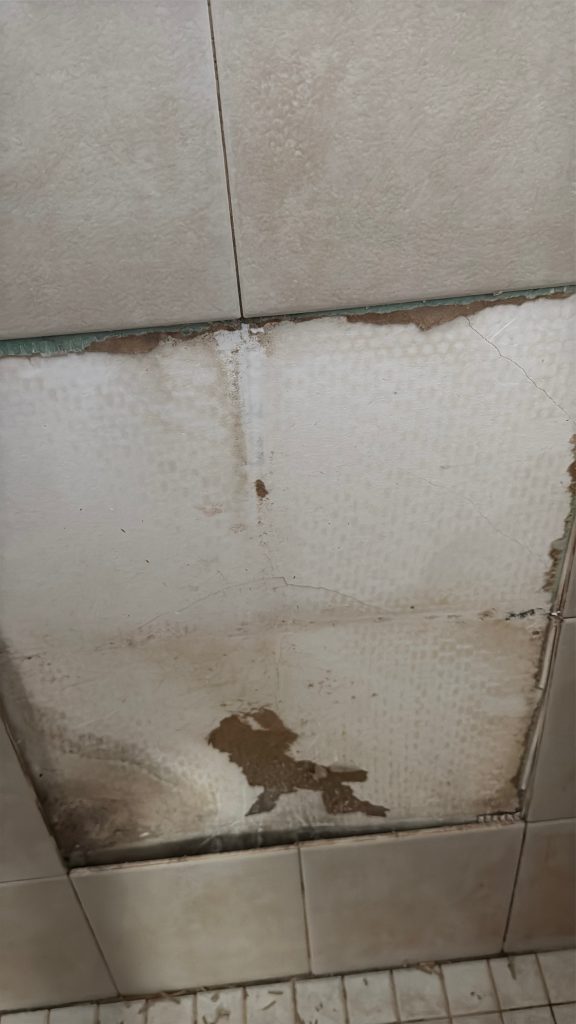
I was looking at a shower recently, and at first glance, other than missing tile on one of the walls, nothing seemed dramatic. The tile looked decent. The layout was clean. But then I noticed something at the base of the wall — one grout line that didn’t match the rest.
It was slightly recessed. A little inconsistent. Not catastrophic — just… off.
Now here’s where the story takes a turn.
This wasn’t just a cosmetic issue. The homeowner told me that at one point, someone actually fell through the shower floor.
Ouch! Let that sink in.
The tile didn’t just crack. The grout didn’t just discolor. The structure behind had deteriorated to the point where the tile gave way.
And as I kept looking, I started to see all the subtle (and not so subtle) signs of shower failure. Mold, grout lines, tile getting separated from the wall.
I should note at this point that the person who fell through the shower was fine! no significant injuries.
Grouting Is Not Just Aesthetic — It’s an Early Warning System
Most people think of grouting as the finishing touch. The final wipe. The clean lines that pull everything together.
But grout tells a story about what’s happening beneath the surface.
That recessed grout line at the perimeter? It suggested movement. Possibly moisture exposure. Maybe even slight substrate breakdown beneath the tile.
And when moisture is allowed to persist in a shower system — especially if waterproofing is compromised — it doesn’t just stain grout. It weakens structure.
Over time, that moisture can:
- Rot subfloor materials
- Deteriorate framing
- Compromise fasteners
- Soften backer board
- Create hidden voids beneath tile
Eventually, what looks like a solid tiled floor becomes a thin shell over failing structure.
That’s how someone falls through a shower.
How Showers Actually Fail
Water passes through grout. That’s normal. The protection comes from:
- A properly sloped pan
- A continuous waterproof membrane
- Correctly detailed seams and transitions
- Functional drainage
If any of those layers fail — especially over time — water migrates downward and outward.
Wood framing doesn’t need much moisture to begin degrading. Once rot starts, it spreads quietly. You won’t see it immediately from above.
But grout can give you clues.
In this case, the uneven grout at the perimeter may have been one of the first visible signs that something below wasn’t behaving correctly.
The Floor-to-Wall Joint Is a Critical Zone
The joint where the shower floor meets the wall is one of the highest-risk areas in any installation.
Why?
- It’s a change of plane (movement occurs here).
- Water pools in this area frequently.
- It’s often incorrectly grouted instead of properly caulked.
- It’s under constant expansion and contraction stress.
Rigid grout in that joint can crack. Once cracks form, water infiltration accelerates.
If slope is insufficient or waterproofing laps aren’t detailed correctly, that moisture can begin attacking the substrate below.
And once the subfloor begins to soften, it doesn’t take much weight to create deflection.
Deflection leads to cracked tile.
Cracked tile leads to more water entry.
And in extreme cases — collapse.
Why This Is a Safety Issue, Not Just a Remodeling Issue
When someone falls through a shower floor, we’re no longer talking about discoloration or callbacks.
We’re talking about:
- Personal injury
- Liability exposure
- Structural damage
- Expensive remediation
- Potential mold growth
According to the CDC, bathroom falls are already one of the leading causes of injury in homes. When structural compromise is added to the equation, the risk multiplies.
A failed shower floor isn’t just inconvenient — it’s dangerous.
And that’s why I take small grout irregularities seriously.
What You Should Look For
If you want to prevent something like this from happening, here are the early signs to monitor:
? Recessed or uneven grout at the perimeter
? Persistent dark grout lines that don’t dry out
? Cracks forming at floor-to-wall transitions
? Soft or spongy feeling underfoot
? Tile movement when pressure is applied
? Efflorescence or mineral deposits
None of these automatically mean collapse is imminent. But they mean investigation is warranted.
Please check out this article we wrote a while back on waterproofing to learn more about it!
Understanding grout behavior is part of understanding shower longevity.
Installation Matters More Than Appearance
A shower that looks good on day one can still fail if it wasn’t properly waterproofed.
Surface beauty can hide systemic weakness.
That’s why professionals evaluate performance indicators — not just aesthetics.
Conclusion
Shower failure is far too common, and it’s not just aesthetic, it’s a safety risk.
And when I heard that someone had actually fallen through that shower, it reinforced something important: small surface details can reflect major structural realities.
If you see something that looks “off,” don’t ignore it. Investigate it.
Because when moisture and structural materials interact unchecked, the consequences aren’t cosmetic — they’re physical.
A safe shower isn’t just about tile alignment. It’s about water management, structural integrity, and attention to detail at every layer.
Is your shower waterproofed? Are you starting to see signs of shower failure?
We can help!