
In our recent “Rob Reacts to Tik Tok Episode“, I reacted to a TikTok talking about the “7 deadly sins of tile work,” There is so much to discuss in all of these points!
Not properly leveling, flattening, or sloping the floor before tile installation.
Because this is one of those mistakes that can quietly ruin an otherwise beautiful project.
And the worst part?
A lot of the time, homeowners don’t even realize the problem started before the tile was installed.
Flat and Level Are Not the Same Thing

This is where people get confused.
A floor can be level but not flat.
And a floor can be flat without being perfectly level.
In tile work, especially with large-format tile, flatness is incredibly important because tile follows whatever surface it’s installed on.
If the substrate has dips, humps, waves, or uneven transitions, the tile will expose every single one of them.
That’s when you start seeing lippage, uneven edges, awkward grout joints, hollow spots, and floors that just feel “off” when you walk on them.
And once the tile is installed, fixing those issues becomes expensive very quickly!
Why Slope Matters Even More in Wet Areas
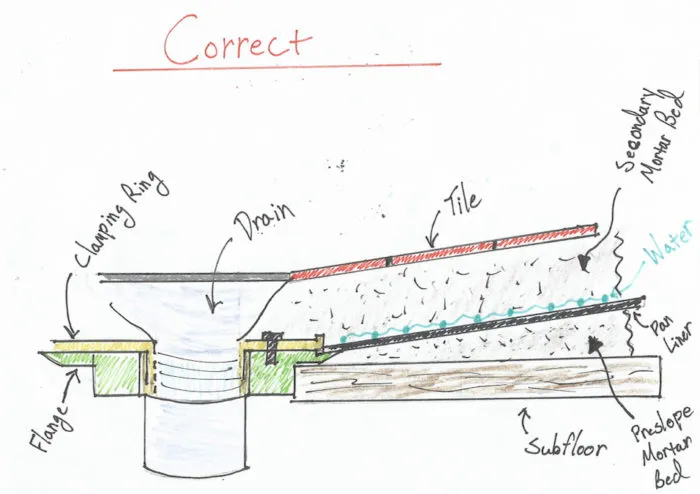
Now let’s talk about showers for a second.
This is where improper slope becomes a true “deadly sin.”
A shower floor is supposed to slope toward the drain. That’s not optional. Water needs direction. Without proper pitch, water sits where it shouldn’t.
And standing water creates problems fast.
Not always dramatic, immediate problems — which is actually what makes this issue dangerous.
Instead, you get the slow stuff: persistent moisture, soap buildup, mildew, funky smells, staining,
and long-term deterioration.
Sometimes homeowners think they have a grout problem when the real issue is that the shower was never sloped correctly in the first place.
The tile is just revealing the mistake underneath.
The Hardest Part of Tile Work Usually Happens Before Tile
This is something most people outside the trade don’t realize.
Some of the most important work in a tile installation happens before a single tile is set.
Surface prep.
Flattening.
Patching.
Self-leveling.
Creating proper slope.
Checking transitions.
Fixing framing issues.
None of that is glamorous content for social media.
Nobody posts a perfectly flattened substrate and gets a million views.
But experienced installers know that prep work is what determines whether the finished installation looks clean and performs properly years later.
Large Format Tile Changed the Game

Years ago, smaller tile could hide a lot of imperfections.
Modern large-format tile?
Not a chance.
Today’s tile is less forgiving than ever. A tiny dip or hump that may have gone unnoticed years ago becomes painfully obvious once large tile goes down.
That’s why prep standards have become more important than ever in the industry.
The larger the tile, the more critical flatness becomes.
(btw, we wrote about Large Format Tile too! you can check it out here)
Wrapping it up
Calling poor floor prep a “deadly sin” might sound dramatic… but honestly, I understand the point.
Because when installers skip proper flattening or ignore slope requirements, they’re creating problems that no amount of beautiful tile can fully hide later.
Good tile work starts long before the tile itself.
And sometimes the difference between an average installation and a truly great one is simply the willingness to spend extra time getting the surface underneath right first.