
In this video, Rob gives homeowners his perspective on what 3 things you are buying when you buy tile.
Walking into a tile showroom can get overwhelming pretty quickly.
There are hundreds of colors, sizes, textures, finishes, and price points. One tile looks like marble. Another looks like wood. Another looks almost identical but costs twice as much.
So how do you actually compare them?
When we help homeowners shop for tile, we like to break it down into three basic things:
the body, the surface, and the aesthetics.
You don’t need to become a tile expert before remodeling your bathroom. But understanding those three areas can help you make a much better choice.
1. Look at the Body of the Tile

The first thing to consider is what the tile itself is made of and how dense it is.
One of the biggest distinctions homeowners see is ceramic versus porcelain. Both are types of ceramic tile, but porcelain is generally manufactured to be denser and less absorbent.
Why does density matter?
A denser tile has fewer open spaces inside the body for moisture to enter. It also tends to be a tougher material, which can be useful in areas where the tile is going to see regular wear.
That doesn’t mean every project automatically needs the densest tile available.
A decorative wall tile on a kitchen backsplash has a very different job from a floor tile in a busy bathroom.
The important thing is understanding where the tile will be installed and choosing a material appropriate for that location.
This is also why we don’t recommend buying tile based on appearance alone. Two tiles can look almost identical from the front and perform very differently once they’re installed.
2. Pay Attention to the Surface
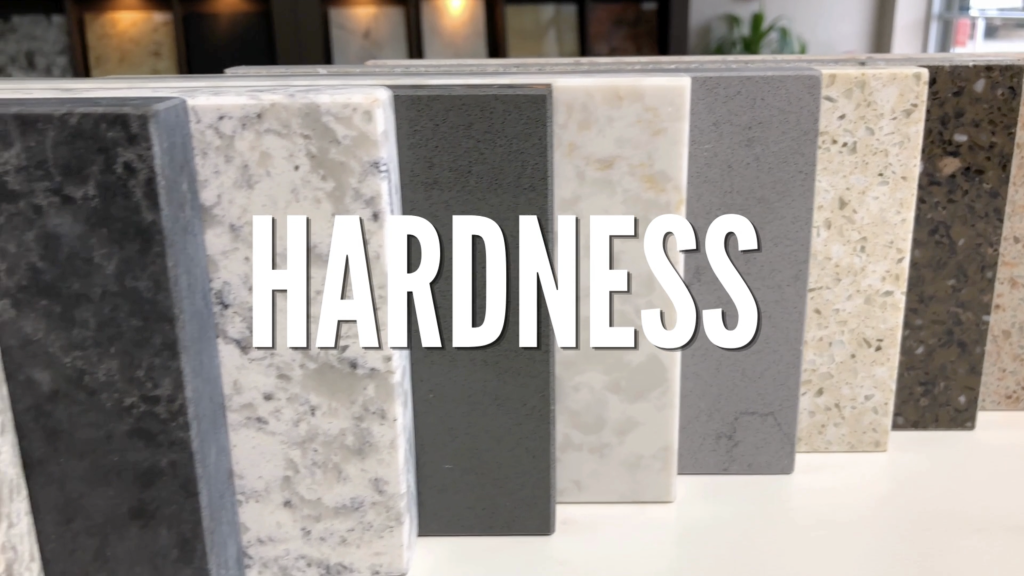
The second thing we look at is the surface of the tile.
How easily can it scratch? How much wear is it designed to handle? Is the finish appropriate for a floor, or is it better suited for a wall?
You can sometimes get a basic sense of the surface by handling samples and comparing them, but manufacturer specifications are important here too.
A glossy decorative tile may be perfect on a shower wall and a poor choice for a heavily traveled floor.
Likewise, a tile designed for flooring may have a surface intended to handle much more abrasion.
And don’t forget about texture.
Something that looks great on a showroom board may feel completely different under bare feet. For shower floors in particular, we also have to think about traction and how the tile will behave when it’s wet.
The prettiest tile in the showroom isn’t necessarily the best tile for every surface in your house.
3. Look at the Pattern—and How Often It Repeats

This is one homeowners often overlook.
A lot of today’s porcelain tile is designed to imitate natural materials such as marble, limestone, or other stone.
Manufacturers can create extremely convincing images.
But there’s a big difference between a tile collection with many different faces and one where the same image repeats every few pieces.
Put four samples on a showroom board and you may never notice it.
Install 300 square feet and suddenly you might see the same vein, knot, or mark appearing over and over again.
Once your eye catches a repeating pattern, it’s surprisingly difficult to stop seeing it.
Higher-quality stone-look collections often provide more variation between pieces. Good installers will also rotate and distribute the tiles during installation so identical faces don’t end up sitting right beside each other.
On the other hand, repetition isn’t always bad.
Some tiles are specifically designed to create a repeating geometric or decorative pattern. In that case, repetition is the entire point.
The question is whether the pattern is supposed to repeat.
Don’t Shop for Tile by Color Alone
Most homeowners naturally begin with aesthetics.
And they should. You’re going to look at this tile every day, so you need to like it.
But once you’ve found something you love, take another minute and ask:
What’s the body? How is the surface rated? How much variation does the pattern have?
Those questions can help separate two products that initially appear almost identical.
They can also prevent you from choosing a beautiful tile for the wrong application.
Bring the Installer Into the Conversation Early
One of the best things you can do is involve your tile contractor before placing the final order.
We can look at the tile size, finish, pattern, intended location, and layout and identify potential issues before several thousand pounds of material arrive at your house.
Sometimes we’ll tell you the tile is a great choice.
Sometimes we’ll point out something you hadn’t considered.
And occasionally we’ll save you from falling in love with a material that’s going to make everybody miserable.
For homeowners in Englewood, Venice, North Port, and throughout Southwest Florida, we’d love to help you evaluate tile based on more than just the sample board. The right tile should look good, perform well in the space, and still be a decision you’re happy with after the showroom excitement wears off.
Debating between marble or porcelain? Check out this article!