
This article is based on this video.
In Part One, we discussed why “dustless demolition” can create unrealistic expectations.
That does not mean contractors should simply accept a dusty mess.
Professional equipment, careful containment, and good jobsite habits can make a major difference. The goal is not to pretend dust does not exist. The goal is to control it, contain it, and clean it as thoroughly as reasonably possible.
What Good Dust Control Looks Like

Depending on the size and difficulty of the project, professional dust-control measures may include:
- Plastic containment around the work area
- Covering cabinets, counters, furniture, and fixtures
- Closing or protecting nearby openings
- Vacuum systems connected to demolition and grinding tools
- Air filtration or air-scrubbing equipment
- Fans arranged to control airflow
- Protecting paths used to carry debris outside
- Frequent cleanup throughout the day
- Sealing off areas of the home that are not part of the project
The exact setup should match the actual demolition.
Removing a small kitchen backsplash is different from removing tile throughout an occupied home. A contractor should evaluate the project instead of automatically using the same setup every time.
The Equipment Helps, but not it’s not perfect.
Specialized tile-removal machines and vacuum systems can make demolition significantly cleaner.
A vacuum positioned directly at the source can capture much of the debris before it becomes airborne. Tool shrouds can also help contain dust while concrete or thinset is being ground.
But these systems are not force fields.
A vacuum hose can shift. A tool may need to reach an awkward area. Broken material still has to be collected, moved, and carried outside. Dust can also escape when containment is opened or debris is emptied.
The presence of dust does not automatically mean the equipment failed. The important question is whether the crew took reasonable steps to control and limit it.
Protecting the Home Is Part of the Job
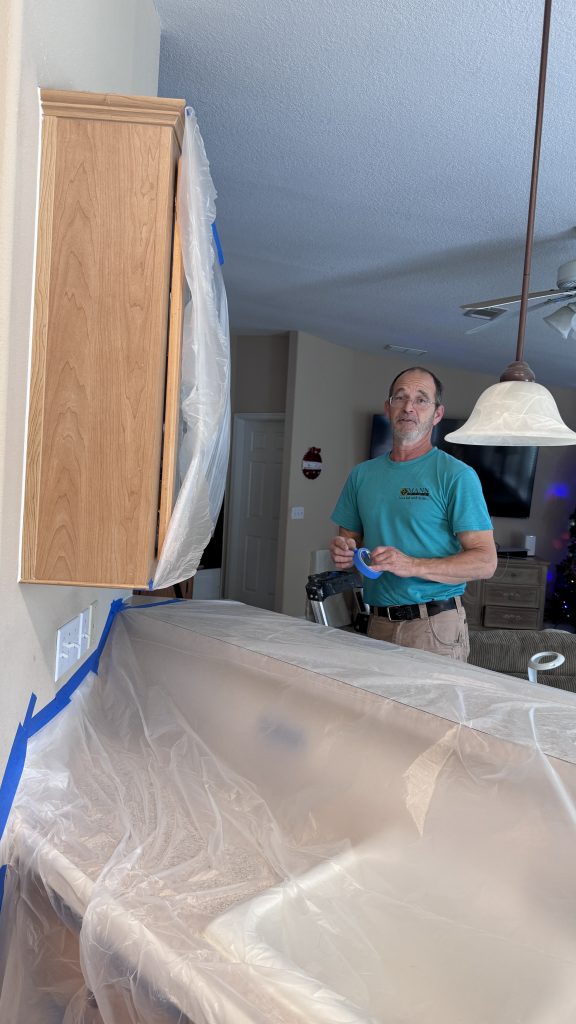
Good demolition begins before the first tile is broken.
The crew should identify areas that need protection, determine how debris will leave the home, and think about how air moves through the space.
That may mean covering a nearby vanity, protecting a finished floor, closing doors, sealing an opening, or creating a dedicated path from the work area to the exterior.
These steps take time, but they usually save much more time during cleanup.
Protection is especially important when remodeling an occupied home. The homeowner may still be living, cooking, working, or caring for children and pets in nearby rooms.
The work should disrupt the rest of the house as little as reasonably possible.
Cleanup Should Happen Throughout the Project
Waiting until the end of the day to deal with all the dust and debris is not always the best approach.
Frequent cleanup helps keep material from being tracked into other areas. It also makes the work zone safer and allows the crew to see what is happening beneath the removed tile.
Demolition is naturally messy, but the jobsite should not become unnecessarily chaotic.
There is a difference between a room that is actively being demolished and a room that is simply being neglected.
Less Dust Is Still a Real Benefit
None of this means dust-control services are pointless.
Reducing airborne dust can make a major difference in how clean and manageable the project feels. Better tools and preparation can keep a difficult demolition from affecting the rest of the home nearly as much as it otherwise might.
The problem is not the effort to reduce dust.
The problem is treating dustless as an absolute guarantee.
A more honest promise would be:
We will use professional tools, proper containment, and careful cleanup to reduce and control the dust as much as possible.
That may not fit quite as neatly on a roadside sign, but it gives the homeowner a much more accurate picture of responsible demolition.
The Reality of Remodeling
It’s gonna get messy before it gets better.
There will be noise. There will be broken tile. There will be buckets of debris. There may also be a moment when your house looks like we made a terrible life decision.
That is the reality of demo.
Our job is to plan for it, protect the surrounding home, communicate honestly, and clean up after ourselves—not pretend that breaking hundreds of square feet of tile will be as tidy as folding laundry.
For homeowners in Englewood, Venice, North Port, and neighboring communities, Mann Tile approaches tile demolition with realistic expectations, careful preparation, and practical dust-control methods.
We would rather tell you the truth before the project begins and then work hard to make the process cleaner than expected.